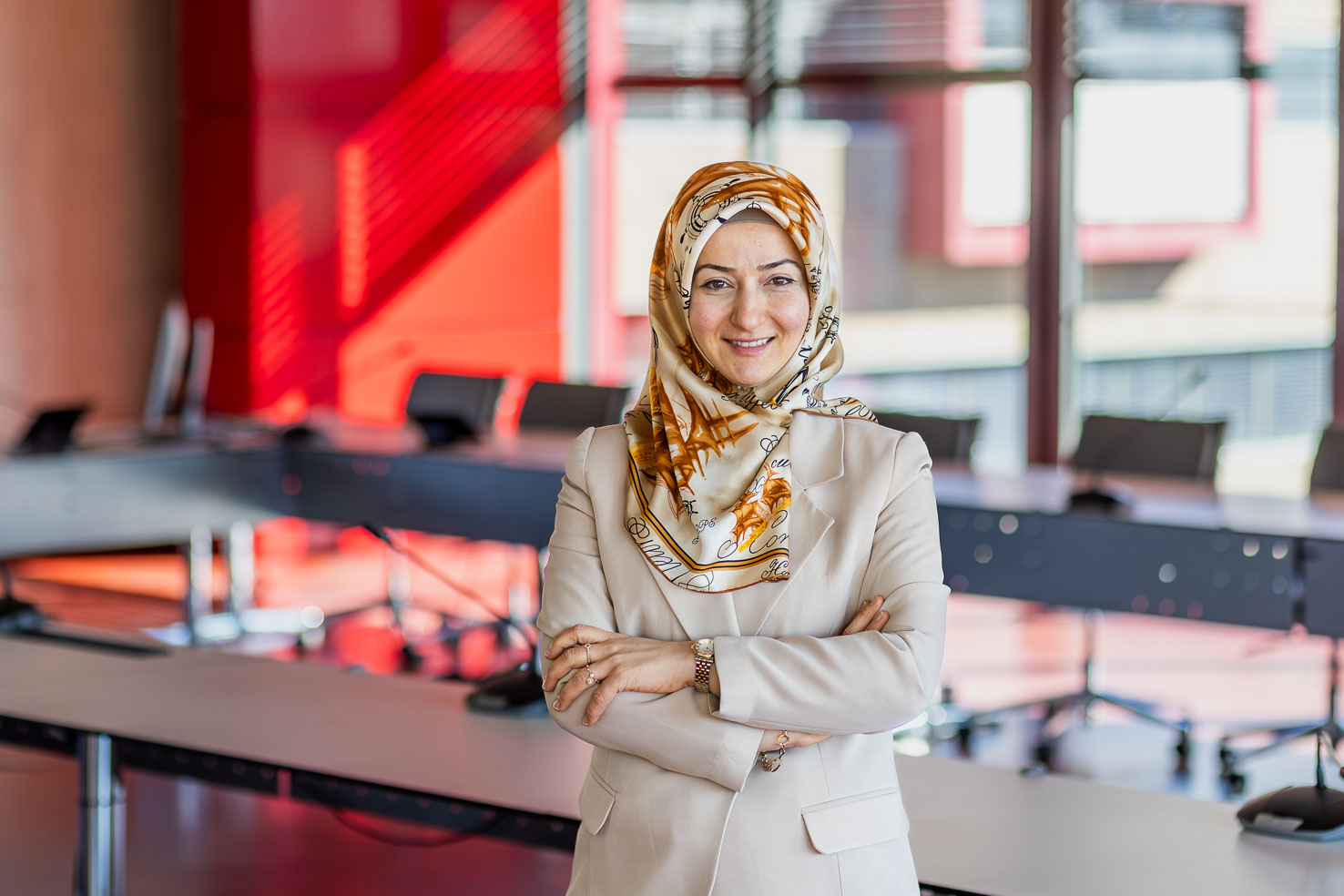
Prof.in Dr. Aysegül Dogangün
Institut Informatik
Email:
ayseguel.doganguen@hs-ruhrwest.de
Telephone:
+49 208 88254-943
Please send appointment requests by email.
Professor of Human-Centred Technology Development
Expertin für menschzentrierte Technik: Prof.in Dr. Aysegül Dogangün
Im Fachgebiet von Dr. Aysegül Dogangün geht es darum, Technik menschenfreundlich zu entwickeln.
Fachgebiet: Menschenzentrierte Technikentwicklung
"Wie kann ich neue Technologie entwickeln, damit sie für den Menschen wirklich hilfreich ist?" Das ist die Grundfrage, nach der sich Prof. Dr.-Ing. Aysegül Dogangün bei allen ihren Forschungsvorhaben richtet. Bei ihrer Arbeit spielt das Sammeln, Auswerten und Bereitstellen relevanter Informationen aus großen Datenmengen eine wichtige Rolle.
Aysegül Dogangün hat in Berlin Informatik mit dem Nebenfach Psychologie studiert, sie arbeitete am Fraunhofer Institut für Mikroelektronische Schaltungen und Systeme in Duisburg und reichte 2012 ihre Promotion an der Universität Duisburg Essen ein, für die sie ein Assistenzsystem für Menschen mit Demenz entwickelte.
Ab 2015 leitete sie dort die interdisziplinäre Forschergruppe zum Thema „Personal Analytics“, die sich mit Assistenzsystemen für Medizin und Pflege (Digital Health) beschäftigte. Dabei ging es unter anderem um die Entwicklung von Gesundheitsanwendungen für Menschen 50+. Diese sollten es den Nutzern ermöglichen, ein Selbstmonitoring durchführen zu können, auf dessen Basis Hinweise generiert wurden, wie das persönliche Gesundheitsverhalten (z. B. körperliche Aktivität, Ernährung, Schlaf etc.) verbessert werden kann. „Wie muss eine solche Technologie gestaltet sein, damit sie zur Nutzung anregt und wirksam ist?”, „Welche Emotionen spielen eine Rolle bei der Mensch-Technik-Interaktion?", „Wie können diese in der Mensch-Technik-Interaktion zur Verbesserung dieser genutzt werden?”. Diese und weitere Fragen leiteten die Forschung.
2018 erhielt die Wissenschaftlerin den Ruf an die HRW mit dem Lehrgebiet Menschzentrierte Technikentwicklung. Seither arbeitet sie daran, neue und zeitgemäße Lehrkonzepte umzusetzen, aber auch Forschungsprojekte durchzuführen.
Person
Prof. Dr.-Ing. Ayşegül Dogangün is Professor of Human-Centred Technology Development at Hochschule Ruhr West. Her work focuses on the design of responsible, inclusive and explainable AI and interaction systems at the intersection of computer science, society and applied practice.
In interdisciplinary research and transfer projects with partners from academia, public administration, healthcare and industry, she manages an extensive third-party funded research portfolio, including projects on social robotics, digital inclusion, assistive technologies in care, and Human-Centred AI.
In addition to her research, she is strategically engaged in university committees and in ethical questions surrounding the use of artificial intelligence. As an expert member of the Working Group on Artificial Intelligence and Neurotechnology within the VDI initiative “Zukunft Deutschland 2050”, and as a regular reviewer for funding programmes of federal and state ministries, she also contributes her expertise to supra-regional innovation and funding structures.
In her teaching, she emphasises project-based and participatory learning approaches and prepares students for the human-centred design of digital innovation.
Sprechstunde nach Vereinbarung (online oder vor Ort, Campus Bottrop).
Terminanfragen bitte per E-Mail.
Since September 2018 2015–2020 2010–2014 2012 2008
|
- Member of the Executive Board, Research Institute for Positive Computing
- Deputy Chair of the Ethics Committee, Hochschule Ruhr West
- Founding Member and Co-Spokesperson of JF:Tech – Young Forum for Engineering Sciences
- Member of VDI/VDE
- Expert Member of the Working Groups on Artificial Intelligence and Neurotechnology within the VDI initiative “Zukunft Deutschland 2050”
- Regular reviewer for funding programmes of federal and state ministries (via VDI/VDE)
Teaching
- Fundamentals of Psychology and Ergonomics
- Human and Technology I – Fundamentals of Psychology and Ergonomics
- Human and Technology II
- Software Ergonomics and Usability Engineering
- UX Design for Mobile Devices
- Inclusive IT Design
- Supervision of student projects at Bachelor’s and Master’s level, as well as final theses
- Supervision of project work and final theses in English
- International cooperation projects in the fields of Human-Centred AI, Social Robotics and Sustainability
|
Regular supervision of Bachelor’s and Master’s theses in the following areas:
- Human–Computer Interaction
- Explainable AI
- Social Robotics
- Digital Inclusion
- Care and Assistive Systems
- UX Evaluation
- Sustainability and Drones
- Technology Acceptance Research
https://hrw-mte.de/
Research and Cooperation
Strategic development, evaluation and transfer of human-centred AI and interaction systems.
Interdisciplinary supervision of research staff, doctoral candidates and final theses in cooperation with partners from computer science, psychology, nursing science and public administration.
Prof. Dogangün is responsible for and coordinates an extensive third-party funded research portfolio, supported by federal and state funding programmes (including BMBF, EFRE, BMWK and BMFSFJ) with a total volume of several million euros. The projects are developed in interdisciplinary cooperation with universities, municipalities, healthcare and care institutions, as well as partners from industry and civil society, and are tested in real-world application contexts.
Current and Recently Completed Projects
- PalliCare.ai – AI-based assistance systems for palliative care
EFRE · 2026–2029 · approx. €1.6 million - KI-InnoMATiV – AI-supported innovation and digitalisation approaches for public administration and inclusion
EFRE · 2026–2029 · approx. €2.8 million - RuhrBots – Phase 2 – Social robotics for citizen-oriented public services
BMBF · 2026–2028 · approx. €2.0 million - ExpliCareNEXT – Explainable AI systems to support home-based care
BMWK · 2024–2026 · approx. €1.7 million - KISS – Digital solutions to promote mobility and social participation among older adults
BMFSFJ · 2023–2025 · approx. €0.8 million - DESCPOS – Service learning and participatory technology design
Foundation for Innovation in Higher Education · 2022–2024 · approx. €0.4 million - PAnalytics – Personal analytics and health-related self-monitoring
BMBF · 2015–2020 · approx. €2.8 million
- Human-Centred AI
- Social Robotics and Drones
- Digital Participation and Inclusion
- Explainable AI
- Care and Assistive Technologies
- Technology Impact Assessment
- Knowledge Transfer into Public Administration and Practice
Publications (Selected)
2025
- Meske, C., Brenne, J., Uenal, E., Oelcer, S. & Doganguen, A. (2025). From Explainable to Explanatory Artificial Intelligence: Toward a New Paradigm for Human-Centered Explanations through Generative AI. arXiv. https://doi.org/10.48550/arXiv.2508.06352
- Hermann, J., Jansen, N., Dogangün, A. & van Ledden, S. (2025). Implicit SDG Reasoning in LLMs: A Classroom-Oriented Benchmark. In Proceedings of the 37th Australian Human-Computer Interaction Conference (OzCHI ’25), November 29–December 3, 2025, Sydney, Australia. ACM, New York, NY, USA 10 Pages https://doi.org/10.1145/3764687.3769916
- Hermann, J., Jansen, N. & Dogangün, A. (2025). Surfacing Tensions in Digital Inclusion: A World Café Synthesis. In 37th Australian Conference on Human-Computer Interaction (HCI) (OZCHI ’25), November 29-December 03, 2025, Sydney, Australia. ACM, New York, NY, USA 12 Pages. https://doi.org/10.1145/3764687.3769914
- Mattick, X., Dogangün, A., Hey, C.-C., Afzali, S. N. & Kubullek, A. (2025). Comparing Voice and Touch-Based Onboarding for Older Adults. In Proceedings of the 37th Australian Human-Computer Interaction Conference (OzCHI ’25), November 29–December 3, 2025, Sydney, Australia. ACM, New York, NY, USA. https://doi.org/10.1145/3764687.3769911
- Kubullek, A., Erdem, D. & Dogangün, A. (2025). AI vs. Human Fashion Consultation for Young Women: A Quantitative Survey on Expectations, Formats, and the Potential to Promote Body Positivity. In Proceedings of the 37th Australian Human-Computer Interaction Conference (OzCHI ’25), November 29–December 3, 2025, Sydney, Australia. ACM, New York, NY, USA. https://doi.org/10.1145/3764687.3769949
- Kubullek, A., Beder, M., Klicic, M., Roth, S. & Dogangün, A. (2025). Building Bridges in Robotics – Ideation and Design of a B2B-Platform to Connect Robotics Providers and Enquirers. In Proceedings of the 37th Australian Human-Computer Interaction Conference (OzCHI ’25), November 29–December 3, 2025, Sydney, Australia. ACM, New York, NY, USA. https://doi.org/10.1145/3764687.3769929
- Hermann, J. & Dogangün, A. (2025). Toward Dialogue: Longitudinal Shifts in Computing Students’ Discourse Through Sustained Engagement with People with Diverse Support Needs. In 37th Australian Conference on Human-Computer Interaction (HCI) (OZCHI ’25), November 29-December 03, 2025, Sydney, Australia. ACM, New York, NY, USA 15 Pages. https://doi.org/10.1145/3764687.3764698
- Kubullek, A., Zimmer, L., Ly, T. T. M., & Dogangün, A. (2025). Towards Accessibility 2.0 in Higher Education – Evaluating Orientation and Comprehension of Accessibility Requirements with Undergraduate HCI Students. In 37th Australian Conference on Human-Computer Interaction (HCI) (OZCHI ’25), November 29-December 03, 2025, Sydney, Australia. ACM, New York, NY, USA 15 Pages. https://doi.org/10.1145/3764687.3764711
- Lisetschko, A., Jansen, N., & Dogangün, A. (2025). Designing User Experiences with Social Robots: A Field Study on Acceptance in Public Libraries. In ICSR + AI 2025, September 10-12, 2025, Naples, Italy. Springer Nature, LNAI, Berlin, Germany, 17 pages. (accepted, in press)
- Jansen, N., Kubullek, A., & Dogangün, A. (2025). More Than a Tool: A Multi Method Exploration of Contextual Social Robot Roles in German Secondary Schools. In ICSR + AI 2025, September 10-12, 2025, Naples, Italy. Springer Nature, LNAI, Berlin, Germany (accepted, in press)
- Kubullek, A., Hermann, J., Mäder, A.D., Lisetschko, A., & Dogangün, A. (2025). Improving Social Robot Acceptance in Public Libraries by Qualitative Analysis of TAM. In 34th IEEE International Conference on Robot and Human Interactive Communication (RO-MAN) 2025, Eindhoven, Netherlands, August 25 – 29, 2025. https://ieeexplore.ieee.org/document/11217804
- Ölcer, S., Albert, A., Jansky, M., Banse, C., & Nauck, F. (2025). A healthcare provider-centred perspective on emotional appraisals of challenges and strategies in palliative care for patients with a migration background. In Palliative Medicine. https://doi.org/10.1177/02692163251335482.
- Hermann, J., Jansen, N. & Dogangün, A. (2025). We Need to Understand Where the Data Comes From: Co-Designing Transparent AI Systems for Caregiving. In 30th International Conference on Intelligent User Interfaces Companion (IUI Companion ’25), March 24–27, 2025, Cagliari, Italy. ACM, New York, NY, USA, 7 pages. https://doi.org/10.1145/3708557.3716354
- Hermann, J., van Ledden, S., Meske, C., Löhrke, E., Naroska, E., Dimitrov, T., Ölcer, S. & Dogangün, A. (2025). ExpliCareNEXT: Human-Centered Explainable AI Solutions for Nursing Care. In Joint Proceedings of the ACM IUI Workshops 2025 (March 24–27, 2025, Cagliari, Italy). CEUR-WS. https://ceur-ws.org/Vol-3957/HealthIUI-paper06.pdf
- Dogangün, A., & Ölcer, S. (2025). Speech-based assistants in professional healthcare: potentials and challenges in palliative care. In HCII 2025, Part I, CCIS 2522 (Communications in Computer and Information Science) C. Stephanidis et al. (Eds.), pp.1–14, Springer Nature Switzerland AG. https://doi.org/10.1007/978-3-031-94150-4_25
- Afzali, SN., Hey, C.-C., Meske, C., & Dogangün, A. (2025). Technological Horizons in Urban Mobility: A Systematic Review of Mobility Apps’ Capabilities and Applications. The Third IEEE International Conference on Mobility: Operations, Services, and Technologies (MOST). May 4 – 6, 2025, Newark, Delaware, USA. https://ieeexplore.ieee.org/document/11071461
- Hermann, J., Oelcer, S., Hey, C.-C., Dogangün, A. (2025). Explainable Artificial Intelligence (XAI) in Elderly Care: The Impact of Explanations on Trust and Behavioral Intentions of Caregivers. HCI INTERNATIONAL 2025, 27th International Conference on Human-Computer Interaction, Gothenburg, Sweden 22 – 27 June 2025 (accepted, in press)
2024
- Lisetschko, A., van Ledden, S., Mäder, A. D. Jansen, N. & Dogangün, A. (2024). Innovative Solutions for Libraries: A User-Centric Cumulative Study on the Requirements Analysis for the Use of Social Robots. In Proceedings of the 36th Australian Computer-Human Interaction Conference (OzCHI ’24). Association for Computing Machinery, New York, NY, USA, 431–441. https://doi.org/10.1145/3726986.3726987
- Mattick, X., Boadu, J., Dogangün, A., Jansen, N. & Meske, C. (2024). Design for Older People: Improving the Usability of Mobile Apps through Targeted Design Recommendations. In Proceedings of the 36th Australian Computer-Human Interaction Conference (OzCHI ’24). Association for Computing Machinery, New York, NY, USA, 147–158. https://doi.org/10.1145/3726986.3727000
- Hermann, J., Topac, Y., Hoffmann, J., Wedemeyer, L., Jansen, N. & Dogangün, A. (2024). User-Centric Wildlife Monitoring: AI-Powered Animal Detection and Tracking with Drone-Based Thermal Imaging. In Proceedings of the 36th Australian Computer-Human Interaction Conference (OzCHI ’24). Association for Computing Machinery, New York, NY, USA, 682–688. https://doi.org/10.1145/3726986.3727026
- Hermann, J., Reinisch, F., Kuhlen, M., Waldhelm, M., Lakomski, K., Jansen, N. & Dogangün, A. (2024). Volker: An AI-Powered App for Personalized Energy Efficiency Recommendations in Residential Buildings. In Proceedings of the 36th Australian Computer-Human Interaction Conference (OzCHI ’24). Association for Computing Machinery, New York, NY, USA, 689–697. https://doi.org/10.1145/3726986.3727039
- Kubullek, A., van Ledden, S. & Dogangün, A. (2024). A Collection of Standards-based Recommendations for Sustainable, Social, Accessible Robots and Systems in Public Spaces – A Systematic Review and Derivation of Unified Equality Requirement Descriptions. In International Conference on Human-Agent Interaction (HAI ’24), November 24–27, 2024, Swansea, United Kingdom. ACM, New York, NY, USA. https://doi.org/10.1145/3687272.3688294
- Hermann, J., Wedemeyer, L., Topac, Y., Hoffmann, J. & Dogangün, A. (2024). AI-Powered Animal Recognition and Tracking via Drone-Based Thermal Imaging: A User-Centric Mobile Application. In International Conference on Human-Agent Interaction (HAI ’24), November 24–27, 2024, Swansea, United Kingdom. ACM, New York, NY, USA. https://doi.org/10.1145/3687272.3694716
- van Ledden, S., Lisetschko, A., Jansen, N., Jendrusch, D., Hermann, J. & Dogangün, A. (2024). User-Centric Design of Social Robots in City Libraries: Exploration of the Interplay of Social Roles and User Expectations. In Proceedings of the 13th Nordic Conference on Human-Computer Interaction (NordiCHI ’24). Association for Computing Machinery, New York, NY, USA, Article 13, 1–13. https://doi.org/10.1145/3679318.3685346
- Hermann, J., Mäder, A. D. & Dogangün, A. (2024). Nachhaltigkeit gestalten: Aktivierung der Generation Z für ökologisches Engagement durch Persuasive Computing. In Proceedings of Mensch und Computer 2024 (MuC ’24). Association for Computing Machinery, New York, NY, USA, 544–554. https://doi.org/10.1145/3670653.3677522
- Kubullek, A., Kumaç, N. & Dogangün, A. (2024). Understanding the Adoption of ChatGPT in Higher Education: A Comparative Study with Insights from STEM and Business Students. In Proceedings of Mensch und Computer 2024 (MuC ’24), September 1–4, 2024, Karlsruhe, Germany. ACM, New York, NY, USA. https://doi.org/10.1145/3670653.3677507
- Lisetschko, A., Jansen, N., Dogangün, A. & Mäder, A. D. (2024). Interdisciplinary Requirements Engineering for Deploying Social Robots in Public Library’s. In Companion of the 2024 ACM/IEEE International Conference on Human-Robot Interaction (HRI ’24). Association for Computing Machinery, New York, NY, USA, 684–688. https://doi.org/10.1145/3610978.3640657
- Ölcer, S. (2024). A New Life, or Shadows of the Past? Everyday Emotional Experiences of Forcibly Displaced Kurdish Immigrants: A Systematic Review. Nordic Journal of Migration Research. https://doi.org/10.33134/njmr.789
- Ölcer, S., Scheipers, M., Erbsland, M., & Sharma, C. (2024). Innovative approaches in discussions of diabetes among healthcare sector actors in Germany. Journal of Public Health Policy. https://doi.org/10.1057/s41271-024-00509-x
2023
- Hermann, J., Dogangün, A. & Hesenius, M. (2023). Age-Based Differences in Drone Control Gestures: An Exploratory Study. In Proceedings of the 35th Australian Computer-Human Interaction Conference (OzCHI ’23). Association for Computing Machinery, New York, NY, USA, 49–58. https://doi.org/10.1145/3638380.3638401
- Hermann, J., Oktay, S., Lisetschko, A. & Dogangün, A. (2023). A Systematic Literature Review on the Use of Social Robots in Elderly Care. In Proceedings of the 35th Australian Computer-Human Interaction Conference (OzCHI ’23). Association for Computing Machinery, New York, NY, USA, 221–230. https://doi.org/10.1145/3638380.3638412
- Lisetschko, A., Ferizovic, M., Beder, M., Roth, S., van Ledden, S. & Dogangün, A. (2023). Towards an UX/CX research-framework for HRI along the Customer Journey – a methodological note. Mensch und Computer 2023 – Workshopband. DOI: 10.18420/muc2023-mci-ws17-366. GI. MCI-WS17: Robots for Public and Social Spaces – Design for Intent Communication, Collaboration and Acceptance. Rapperswil. 3.-6. September 2023
- Kubullek. A. & Dogangün, A. (2023). Creating Accessibility 2.0 with Artificial Intelligence. In Proceedings of Mensch und Computer 2023 (MuC ’23). Association for Computing Machinery, New York, NY, USA, 437–441. https://doi.org/10.1145/3603555.3608541
- Hermann, J. & Dogangün, A. (2023). Participation between IT Students and People with Disabilities: Initial Findings from a Service-Learning Project. Mensch und Computer 2023 – Workshopband. DOI: 10.18420/muc2023-mci-ws02-443. GI. MCI-WS02: Partizipative und sozialverantwortliche Technikentwicklung. Rapperswil. 3.-6. September 2023
- Hermann, J., Nierobisch, N., Arndt, R., Kubullek, A., van Ledden, S. & Dogangün, A. (2023). The Impact of Explanation Detail in Advanced Driver Assistance Systems: User Experience, Acceptance, and Age-Related Effects. In Proceedings of Mensch und Computer 2023 (MuC ’23). Association for Computing Machinery, New York, NY, USA, 307–312. https://doi.org/10.1145/3603555.3608536
- van Ledden, S., Dogangün, A. & Hermann, J. (2023). ELSI Product Owner: Integration of Ethical, Legal and Social Aspects in Agile Development processes. In Proceedings of Mensch und Computer 2023 (MuC ’23). Association for Computing Machinery, New York, NY, USA, 313–317. https://doi.org/10.1145/3603555.3608538
2022
- Hermann, J., Mäder, A. D., Kubullek, A., Hey, C.-C., & Dogangün, A. (2022). (Intelligent) Technical Systems in Elderly Care: The Caregivers Perspective. In: Proceedings of the 34th Australian Conference on Human-Computer Interaction (OzCHI ’22). Association for Computing Machinery, New York, NY, USA, 81–87. https://doi.org/10.1145/3572921.3572948
- Hermann, J., Plückthun, M., Dogangün, A., & Hesenius, M. (2022, October). User-Defined Gesture and Voice Control in Human-Drone Interaction for Police Operations. In: Nordic Human-Computer Interaction Conference (pp. 1-11). https://doi.org/10.1145/3546155.3546661
- Sieger, L. N., Hermann, J., Schomäcker, A., Heindorf, S., Meske, C., Hey, C.-C. & Doğangün, A. (2022). User Involvement in Training Smart Home Agents: Increasing Perceived Controland Understanding. In: Proceedings of the 10th International Conference on Human-Agent Interaction (HAI ’22), December 5–8, 2022, Christchurch, New Zealand, New York, NY, USA: ACM. https://doi.org/10.1145/3527188.3561914
- Meske, C., Hermanns, T., Jelonek, M. & Dogangün, A. (2022). Enabling Human Interaction in Virtual Reality: An Explorative Overview of Opportunities and Limitations of Current VR Technology. In: Chen, J.Y.C., Fragomeni, G., Degen, H., Ntoa, S. (eds) HCI International 2022 – Late Breaking Papers: Interacting with eXtended Reality and Artificial Intelligence. HCII 2022. Lecture Notes in Computer Science, vol 13518. Springer, Cham. https://doi.org/10.1007/978-3-031-21707-4_9
- Straßmann, C., Eimler, S.C., Peltzer, I., Hermann, J., Dogangün, A. & Roth, S. (2022). User-Centered Robots for Municipal Services: What Do Customers and Service Experts Expect from Robots in Municipal Institutions?. In: Kurosu, M. (eds) Human-Computer Interaction. Technological Innovation. HCII 2022. Lecture Notes in Computer Science, vol. 13303. Springer, Cham. / Human-Computer Interaction. Technological Innovation: Thematic Area, HCI 2022, Held as Part of the 24th HCI International Conference, HCII 2022, Virtual Event, June 26–July 1, 2022, Proceedings, Part II (pp. 639-655). https://doi.org/10.1007/978-3-031-05409-9_46
2021
- Hermann, J., Straßmann, C., Dogangün, A., Roth, S., Eimler, S. (2021). Soziale Roboter in städtischen Einrichtungen des Ruhrgebiets: Eine partizipative Projektkonzeption. Mensch und Computer 2021 – Workshopband. DOI: 10.18420/muc2021-mci-ws06-277. Bonn: Gesellschaft für Informatik e.V.. MCI-WS06: Partizipative und sozialverantwortliche Technikentwicklung. Ingolstadt. 5.-8. September 2021
Regular contributions as author, speaker, reviewer and session chair at international conferences in the fields of Human–Computer Interaction and Artificial Intelligence.
Research Staff
- Julia Hermann – ExpliCareNEXT, KI-InnoMATiV
- Dr Sabahat Ölcer – ExpliCareNEXT, PalliCare.ai
- Xelia Mattick – ExpliCareNEXT, KISS
- Nima Afzali – ExpliCareNEXT, RuhrBots
Teaching Support
- Ann-Kathrin Kubullek
Student Assistants
- Marieke Naß
- inn Schiermeyer
- Jordan Kuhl
- Celine-Chiara Hey
Former Staff
- Leonie Sieger
- Sebastian van Ledden
- Nadine Jansen
- Artur Lisetschko
University Administration
Deputy Chair of the Ethics Committee
Member of the Senate of Hochschule Ruhr West
Ethics Committee of Hochschule Ruhr West
Offers
Workshops on AI, robotics and inclusive technology design (internal project PAROL: We conducted a participatory research study analysing the use of robots in teaching and learning environments in schools across North Rhine-Westphalia. The aim was to explore their potential beyond computer science education and to develop evidence-based recommendations for their broader and more effective integration into the educational process.)
- Project-based teaching in collaboration with real-world partners from public administration, healthcare and industry.
- Opportunities to contribute to externally funded research projects, undertake work placements, work as a student assistant, and complete socially relevant final theses.
- Promotion of interdisciplinary competencies in research, prototyping and evaluation.
Cooperation with companies, municipalities, care institutions and public bodies in the form of:
- Research and development projects
- Living Labs and field pilot studies
- Evaluation of AI and assistive systems
- Usability and UX studies
- Participatory technology design
- Joint funding applications and transfer partnerships
The aim is the practice-oriented development and sustainable implementation of human-centred technologies.
Lectures and demonstrators on social robotics, AI and user-centred innovation.